Switching paint brands is a big step for most hobbyists. Chances are you've spent years building up a sizeable paint collection, with most of it coming from the same manufacturer. Then, for one reason or another, you decide it's time to branch out and try something new.
Before we get into how to start making the switch to a new brand for your miniature painting needs, let's first look at some of the reasons you might want, or even need, to make the switch in the first place.
This paint costs how much more?
As much as we'd all like to think paint manufacturers are simply fellow hobbyists making paint to improve our painting experience, they're also businesses. While a passion for the hobby may have inspired the company in the first place, every business still needs to make a profit to survive.
Raw materials become more expensive, shipping costs increase, and inflation affects almost every part of the supply chain. When those costs rise, paint prices often follow. There's nothing inherently wrong with that. It's simply the reality of running a business.
The important question for us as hobbyists is whether we're still getting good value for our money.
At the time of writing, common miniature paints in the UK range from roughly 16 pence to 32 pence per millilitre. That might not sound like a huge difference until you look at what your money actually buys. Spend around £15 on one of the more affordable paint ranges and you'll come home with roughly 90 ml of paint. Spend the same amount on one of the more expensive ranges and you'll end up with closer to 45 to 50 ml.
That doesn't automatically make one brand better than another. A more expensive range may have colours you love, a finish you prefer, or better availability where you live. However, if you're trying to stretch your hobby budget as far as possible, the cost per millilitre is well worth considering.
Wait, you stopped making the paint I like?
Paints don't last forever. I'm not talking about that one time you forgot to close the lid properly and your favourite pot of Mephiston Red turned into something closer to a hockey puck than paint.
What I mean is that paint ranges evolve. Manufacturers occasionally reformulate paints, rename colours, or discontinue them entirely because they no longer fit the range or simply aren't selling well enough to justify keeping them in production.
Even when a paint hasn't been discontinued, availability can become a deciding factor. Perhaps your local hobby shop doesn't stock the range anymore, online retailers are constantly sold out, or importing the colour you need has become expensive or difficult. None of these are problems with the paint itself, but they can still be enough to make you look elsewhere.
Whether the colour has disappeared completely or simply become difficult to find, you'll eventually need to look for an alternative. That equivalent won't always come from the same manufacturer.
Why does everyone keep recommending that one paint?
If you've spent any amount of time watching painting tutorials on YouTube, browsing hobby forums, or chatting with other painters at your local gaming club, you've almost certainly heard someone say, "You really should try..." followed by the name of a paint range you've never used before.
Recommendations are one of the biggest reasons people decide to try a new brand. Perhaps everyone is talking about how smooth a particular white paint is, how well another range's metallics cover, or how one company's paints flow beautifully through an airbrush.
That doesn't mean your current paints are suddenly bad. It simply means another manufacturer may have solved a problem you've accepted as normal, or produced a colour that better suits the way you like to paint. Sometimes curiosity alone is enough to encourage you to pick up a bottle and see what all the fuss is about.
Maybe one brand isn't the answer
It's easy to fall into the mindset that you should be loyal to a single paint range. After all, the bottles look nice lined up together on the shelf, and it's certainly convenient when every tutorial uses the same names you're familiar with.
The reality is that very few painters stick exclusively to one manufacturer forever.
Perhaps one company makes your favourite metallics, another produces excellent washes, while a third has the best white you've ever used. Maybe your preferred paints come from four or five different companies. You don't have to choose one brand and reject all the others.
In fact, that's exactly what many experienced painters do. They build a collection based on the strengths of each manufacturer rather than limiting themselves to a single range.
So, how do you actually switch?
The good news is that switching paint brands doesn't have to be an all-or-nothing decision. You don't need to box up your current paints, list them on eBay, and replace your entire collection over the weekend.
Many painters never really "switch" at all. Instead, they gradually expand their collection, adding paints from other manufacturers alongside the ones they already own. Over time, you'll naturally discover which paints you reach for most often, and your collection will evolve around your own preferences rather than a single company's catalogue.
A good place to start is with a paint you know well. Pick a colour you've used dozens of times. You already understand how it behaves, how well it covers, how it thins, and what sort of finish it leaves. That gives you a solid baseline against which to compare alternatives.
The next step is finding equivalent colours from other manufacturers. Rather than guessing which paints might be close, look for colour matches and choose one or two that seem promising. This is exactly why I built Hobby Rack's paint comparison tools. They make it easy to compare colours across multiple manufacturers and quickly find paints that are worth trying.
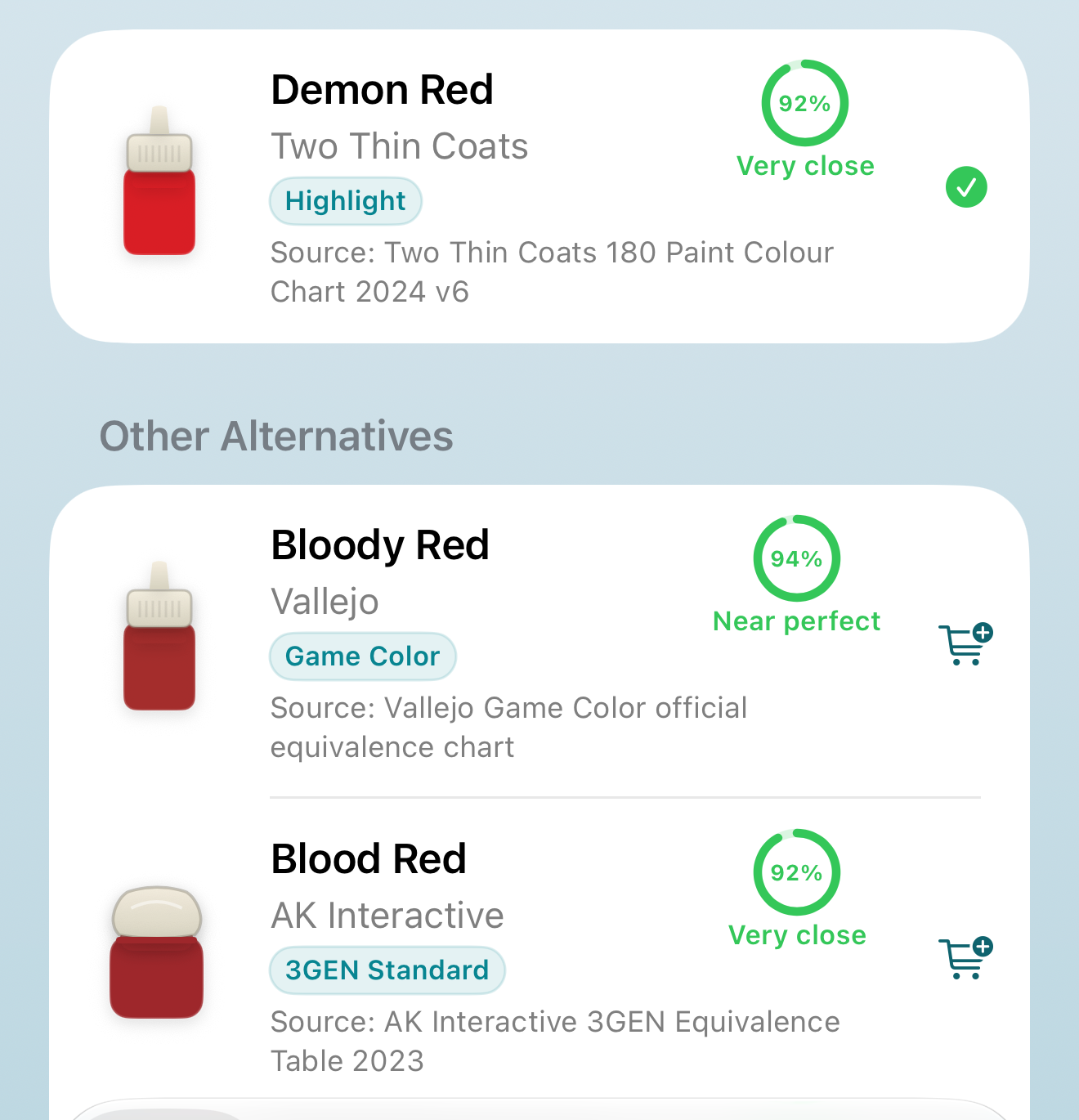
Once you've picked up an alternative, paint with it. Try it on a model you're already familiar with. Pay attention to how easily it covers, how smoothly it flows, how much thinning it needs, and whether you prefer the finish.
You may discover the new paint is better in every way. You may decide your original paint is still your favourite. You might even find that each one excels in different situations.
There isn't a right or wrong answer.
The goal isn't to replace every bottle you own. The goal is to build a paint collection that works for you. If that collection comes from one manufacturer, that's perfectly fine. If it comes from six different manufacturers, that's perfectly fine too.
At the end of the day, your miniature doesn't care whose logo is on the bottle. It only cares that you've painted it.